Key data: the numbers behind Barça’s title win over Füchse
For the final matches of the EHF Champions League Women and the Machineseeker EHF Champions League, data analyst Julian Rux provides the handball community with deep insights into the numbers behind the game, analysing what the data says about teams’ and players’ performances. After Barça's triumph over Füchse Berlin in the title-deciding clash of the TruckScout24 EHF FINAL4 2026, it is time to look at the key statistical takeways from the game.

A flying start
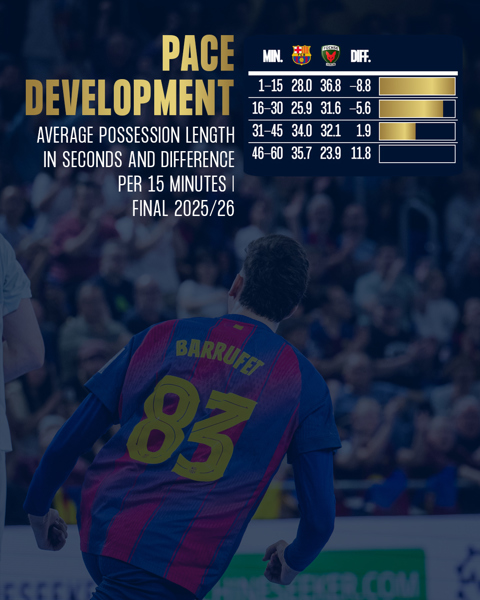
The similar numbers after the game between Barça and Berlin might be a bit misleading, as the Spanish side started the final with a bang by overrunning their German opponents and dictating the pace. In the first half, their possessions were just 26.9 seconds long on average, while Nicolej Krickau’s squad took 7.1 seconds longer — that is how the record champions built up a four-goal lead by half-time.
Barça were especially dangerous after the fast throw-off: in the first half of the final, they scored within 15 seconds after Berlin netted on five occasions. That is the highest number for them in a half in any game this season (tied with three other games from the group stage), while for Füchse it was the second-highest number conceded in a half this season.
Berlin only picked up the pace at the end as time ran out. In the final 15 minutes, they took 23.9 seconds per possession, whereas Barça — who were trying to protect their lead — took 11.8 seconds more.
Berlin's defensive leader Max Darj also saw the start as a major problem: “I think we did not start very well. They were really aggressive. They ran more than us and maybe we were a little bit surprised.”
The best defence in the world
After the final, Berlin’s coach, Nicolej Krickau, stated that Barça “have the best defence in the world by far.” The numbers, of course, reflect that. In our preview article on the TruckScout24 EHF FINAL4 2026, we already discussed their outstanding defence in detail. That is why they were regarded by our model as favourites, and it assigned them the highest probability of winning.
Now, after the final, they still stand clearly on top in defence with opponent-adjusted 25.4 goals conceded per 50 possessions. The difference to second-ranked HBC Nantes (+1.6) is as big as between the second and sixth place. This number is adjusted for the pace of the game because fast-paced games inflate the numbers of goals scored, as well as the strength of the opponents played — due to the fact that teams who reach the final stages have more difficult opponents. The methodology is explained in more detail here.
From this point on, as described earlier, Berlin managed to increase the pace. This was Barça’s weakest defensive spell or Berlin’s strongest offensive spell — however one might choose to look at it. In the final 15 minutes, Füchse converted 84.6 per cent of their shots, the only quarter of the match in which they outperformed Barca, who placed at 76.9 per cent. This was also the only quarter in which they scored more goals, albeit by just one. During these last 15 minutes, Gidsel netted three goals from three attempts, received three seven-metre penalty shots and had just one turnover.
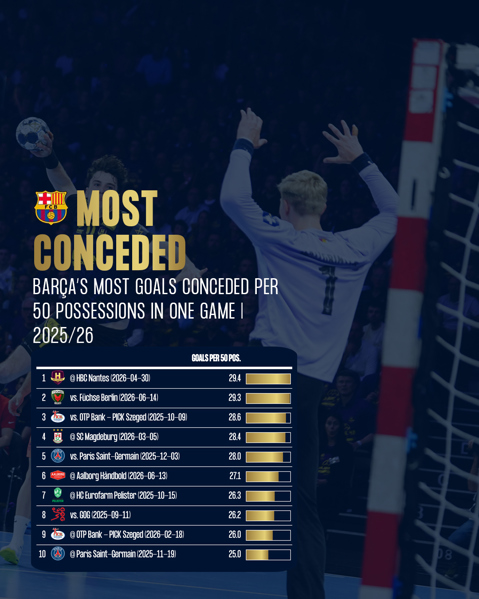
But that, of course, wasn't enough to win the game. However, Berlin’s overall offensive performance was enough for 29.3 goals per 50 possessions, just 0.1 less than Barça’s strongest defence conceded this season.
More from data analyst Julian Rux can be found at Handballytics.de. There you can read his latest articles, in which he analyses all kinds of handball topics from new, data-based perspectives. You can also find him on Instagram, Bluesky and WhatsApp Channels.